
The Vitals That Tell a Story: What Temperature, Heart Rate, and Gut Sounds Are Really Saying
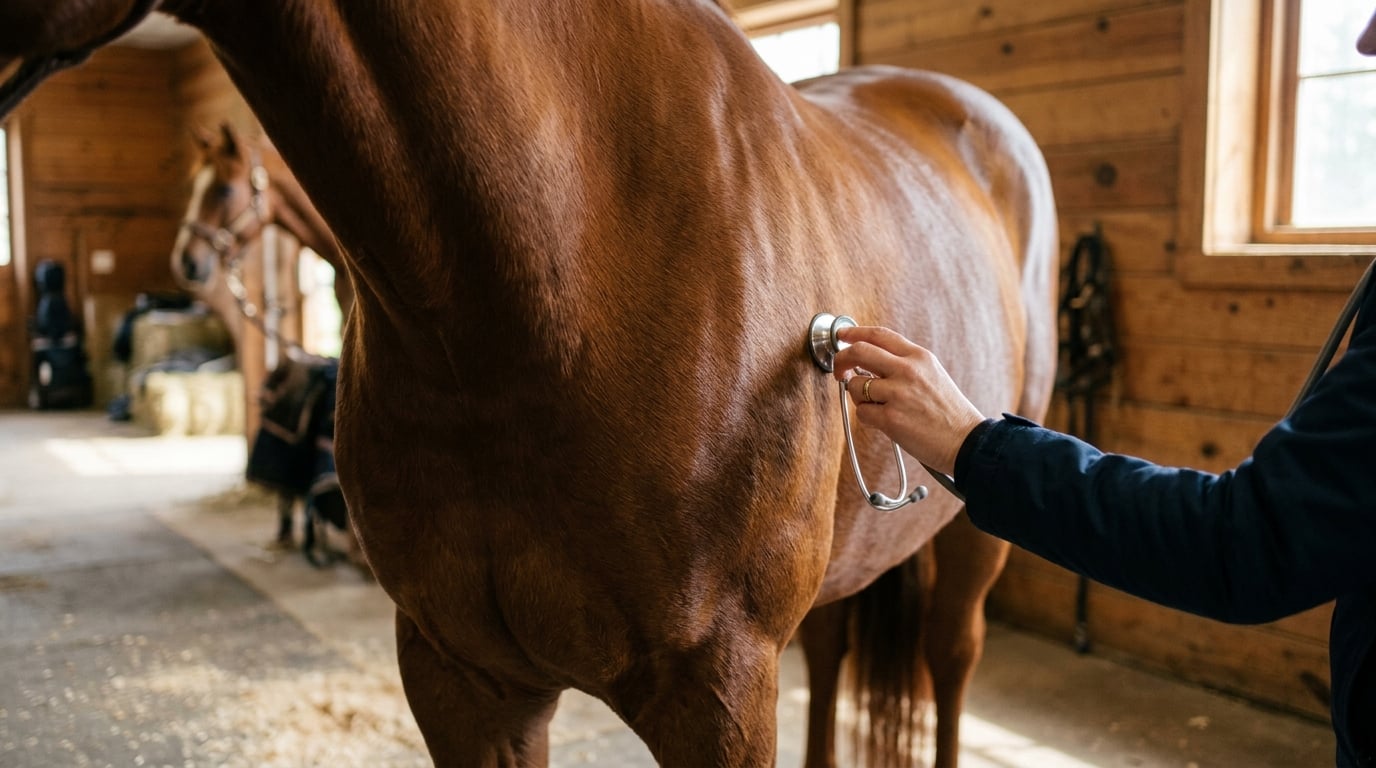
For years, taking my horse's vitals felt like something only the vet was allowed to do. I knew the words — temperature, pulse, respiration, gut sounds — but if you had handed me a thermometer and asked what "normal" looked like, I would have guessed and hoped.
Then one night I had a horse who was a little off, and the vet asked me over the phone, "What's his temp? What are his gut sounds like?" And I had no answer. I stood there in the aisle feeling useless, holding a horse I loved and unable to give the one person who could help the basic information she needed.
I promised myself I would never feel that helpless again. So I learned. And it turns out none of it is complicated — it just needed someone to explain it like a real person instead of a textbook. So here is that explanation.
Why a baseline matters more than a chart
Before we talk numbers, here is the single most important idea: your horse's normal is more useful than the textbook normal.
The published ranges are a starting point, but every horse runs a little different. One of mine has always had a slightly high resting heart rate; another runs cool. If I only knew the textbook average, I might panic over a number that is completely normal for that horse — or worse, miss a real change because the number still technically "fits."
That is why I take vitals on my horses when they are healthy and relaxed, a few times, and write them down. Those calm-day numbers are the baseline. When something feels off later, I am not guessing against a book — I am comparing against this horse on his good days. That comparison is where the real information lives.
Temperature: the honest first number
A normal adult horse runs roughly 99 to 101°F (37.2 to 38.3°C). It is the easiest vital to take and often the most telling.
A fever is one of the clearest early signals that an infection or illness is brewing, sometimes before anything else looks wrong. On the flip side, a low temperature in a horse who is dull or has been down can be its own kind of red flag. Take it rectally, give it a full minute if your thermometer is not digital, and always tie a string to the end — ask any barn owner why, and watch them wince.
The trick is time of day: temperature naturally runs a touch higher in the afternoon and after exercise or a hot day. So a reading of 101.5°F on a sweltering July afternoon after turnout means something very different than the same number at 6am in a cool stall. Context is everything.
Heart rate: the calm-versus-pain tell
A resting adult horse's heart beats around 28 to 44 beats per minute — slow and steady. You can feel it under the jaw where the big artery crosses the bone, or listen behind the left elbow with a cheap stethoscope. Count for 15 seconds and multiply by four.
What makes heart rate so valuable is that it is one of the body's most honest pain gauges. A horse in real discomfort — colic pain especially — will very often run an elevated heart rate even while standing still. When I am watching a possibly-colicky horse (something I wrote about in the colic post), the heart rate trend over time tells me a great deal about whether things are settling or getting worse. A rate that keeps climbing is a rate that gets the vet on the phone.
Just remember that excitement, heat, and exercise all raise it too. Take it when the horse is calm, or you will scare yourself over a perfectly happy horse who just saw the feed cart.
Respiration: quiet and easy
At rest, most horses breathe around 8 to 16 breaths per minute — slow, even, and almost invisible. Watch the flank or the nostrils rise and fall, and count for 15 seconds.
What you are really watching for is effort. Fast, shallow, or labored breathing, flared nostrils at rest, or a heaving line along the belly are all worth attention. As with the others, heat and exercise raise the rate naturally — a horse breathing hard in the shade on a 95-degree day is usually just cooling himself, not sick.
Gut sounds: the one everyone skips
This is the vital most owners never learn, and it is genuinely one of the most useful. Press your ear — or a stethoscope — against the flank, high and low, on both sides, and just listen. A healthy gut is a noisy gut: gurgles, growls, the occasional roar. Those sounds mean things are moving.
The sound that worries me is silence. A quiet, still gut can be an early sign of an impaction or a gut that has stopped moving the way it should — exactly the kind of thing you want to catch early. You do not need to diagnose anything. You just need to be able to tell your vet, "His gut is really quiet on the right side," because that one sentence changes how urgently she responds.
Putting it together
Here is the part that matters: no single number tells the whole story. Vitals are a set. A slightly high temp on its own might be nothing; a high temp with a raised heart rate and a quiet gut and a horse who won't eat is a very different picture. You are learning to read the paragraph, not just one word.
And this is exactly where writing them down changes everything. When you take vitals during a daily health check and log them, you build that baseline I keep mentioning — and you can see trends instead of isolated snapshots. That is the whole idea behind the health-check tracking in EquiNexus: a place to jot temperature, heart rate, and a quick note so the numbers live somewhere you'll actually find them, and so the story stays visible over days instead of vanishing from memory by dinner.
You do not need to become a vet. You just need to be the person who can pick up the phone and say, calmly, "Here are his numbers, and here is what's different from normal." That sentence is a gift to your horse. Learn these four things, take them on a quiet day, write them down — and you'll never feel as helpless as I did in that aisle.
EquiNexus was built by a barn owner to take the mental load off days like these — keeping every horse’s meds, vet dates, and feeding notes in one calm place, so nothing important slips through.
Try it free for one horseNo credit card required.