
The Lesson That Didn't Go to Plan (And Why That's Okay)
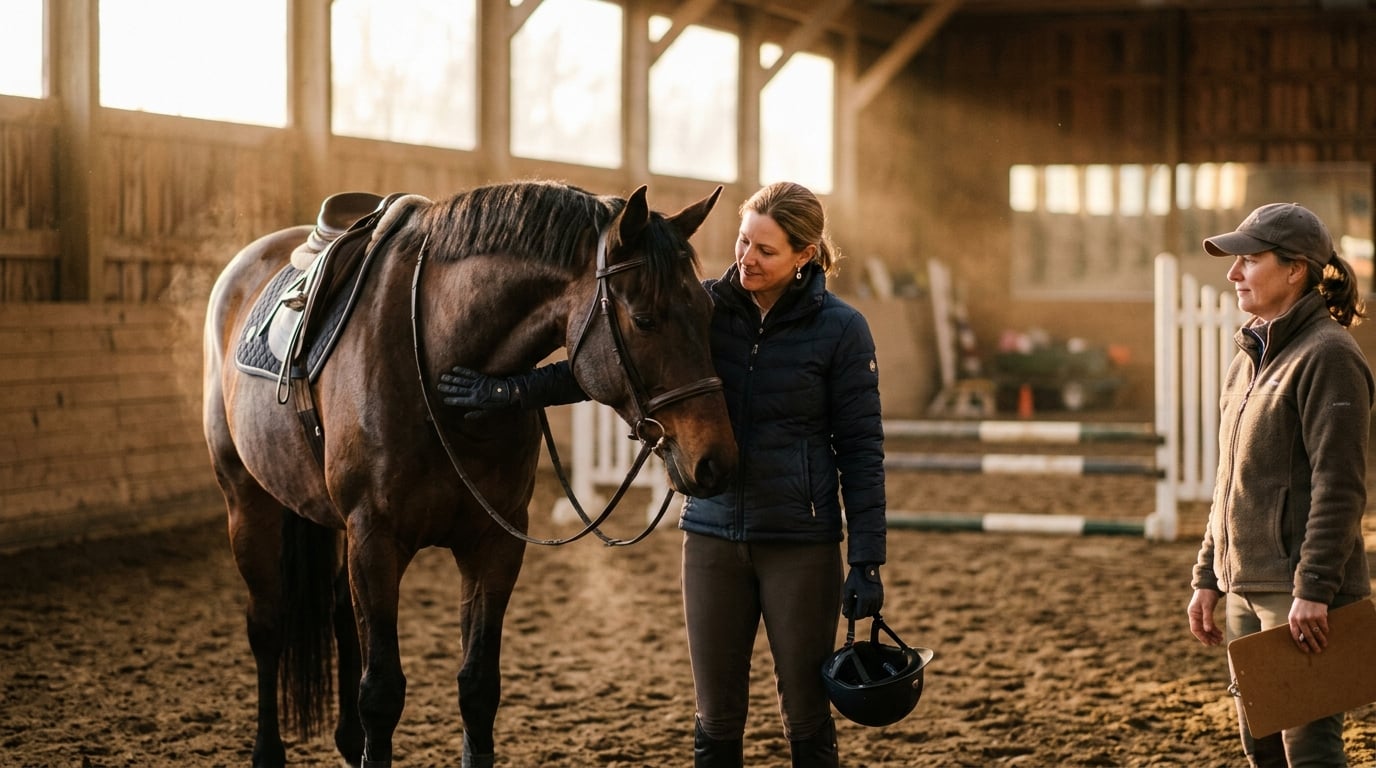
I had a plan for that lesson. We were going to work on our canter transitions — the ones that had finally started to feel smooth the week before. I drove to the barn picturing it: soft, balanced, that little moment of yes when it comes together.
What actually happened was forty-five minutes of a tense horse, a frustrated rider, and canter transitions that felt like being launched out of a catapult. By the end I was near tears, convinced we had gone backward, sure I had somehow ruined the good thing we had built.
My trainer, who has watched a lot of riders have a lot of hard days, just said: "Good. Now you have something real to work with."
It took me a long time to understand what she meant. But I think about it almost every ride now.
The plan was never the point
Here is the trap so many of us fall into, especially those of us who came to riding as adults: we treat the lesson like a performance. We want to show our trainer, and ourselves, that we have improved. We want the clean round, the smooth transition, the proof that the money and the time are paying off.
But a lesson is not a performance. It is a laboratory. And in a laboratory, the experiment that fails teaches you more than the one that goes exactly as expected. The day everything is easy, you learn very little. The day it all falls apart, you find out where the real gaps are — in your position, in your timing, in your horse's understanding, in your own nerves.
A perfect ride feels wonderful and teaches you almost nothing. A messy one feels awful and teaches you everything. We remember the wrong ones as failures when they were actually the lessons.
What "going backward" actually is
That feeling of regression — "we had this last week and now it is gone" — is one of the most demoralizing things in riding. But it is almost never real regression. Usually it is one of a few things:
- Your horse is not a machine. He is a living animal with moods, soreness, weather in his bones, and a memory of the gelding who screamed from the far paddock. Some days he simply has less to give.
- You raised the bar without noticing. Often the thing that "fell apart" did not get worse — your standard got higher. You are now feeling flaws you could not even detect a month ago. That is progress wearing a very convincing disguise.
- You are consolidating. Learning is not a straight line. Skills often wobble right before they lock in. The messy lesson is frequently the last hard step before something clicks.
None of that is comfortable in the moment. But none of it is failure, either.
Write it down before you talk yourself out of the truth
Here is the habit that changed how I ride: I write down what actually happened, as soon as I can after the lesson — before my inner critic rewrites the story into "I was terrible."
Not just "bad lesson." The real notes:
- What we were working on and what my trainer actually said
- What my body was doing when it went wrong — gripping, leaning, holding my breath
- The one or two moments that did work, even briefly
- What we agreed to try next time
When I started keeping honest riding notes, two things happened. First, the "we're going backward" panic mostly dissolved, because I could look back and see the actual arc — the slow, real, upward wobble of it. And second, I stopped losing the good feedback. My trainer would say something brilliant, and by the time I got home it was gone. Now it is written down, and next week I am not starting from scratch.
That is honestly why I built riding logs into EquiNexus the way I did — space for the trainer's feedback, yes, but also for the self-reflection and the small wins, because those are the parts we are most likely to forget and most need to remember on the hard days.
Be as kind to yourself as you are to your horse
We are endlessly patient with our horses. When they struggle, we soften, we break it down, we tell them "it's okay, let's try again." And then we turn that patience completely off when it comes to ourselves, and reach instead for shame.
The next time a lesson falls apart — and it will, because that is riding — try offering yourself the same grace you would offer your horse. Untangle what actually happened. Find the one moment that worked. Write down what to try next. And then let the rest of it go.
The lesson that did not go to plan is not the day you failed. It is very often the day you actually learned to ride.
EquiNexus was built by a barn owner to take the mental load off days like these — keeping every horse’s meds, vet dates, and feeding notes in one calm place, so nothing important slips through.
Try it free for one horseNo credit card required.