
The Day I Learned to Trust the Small Stuff
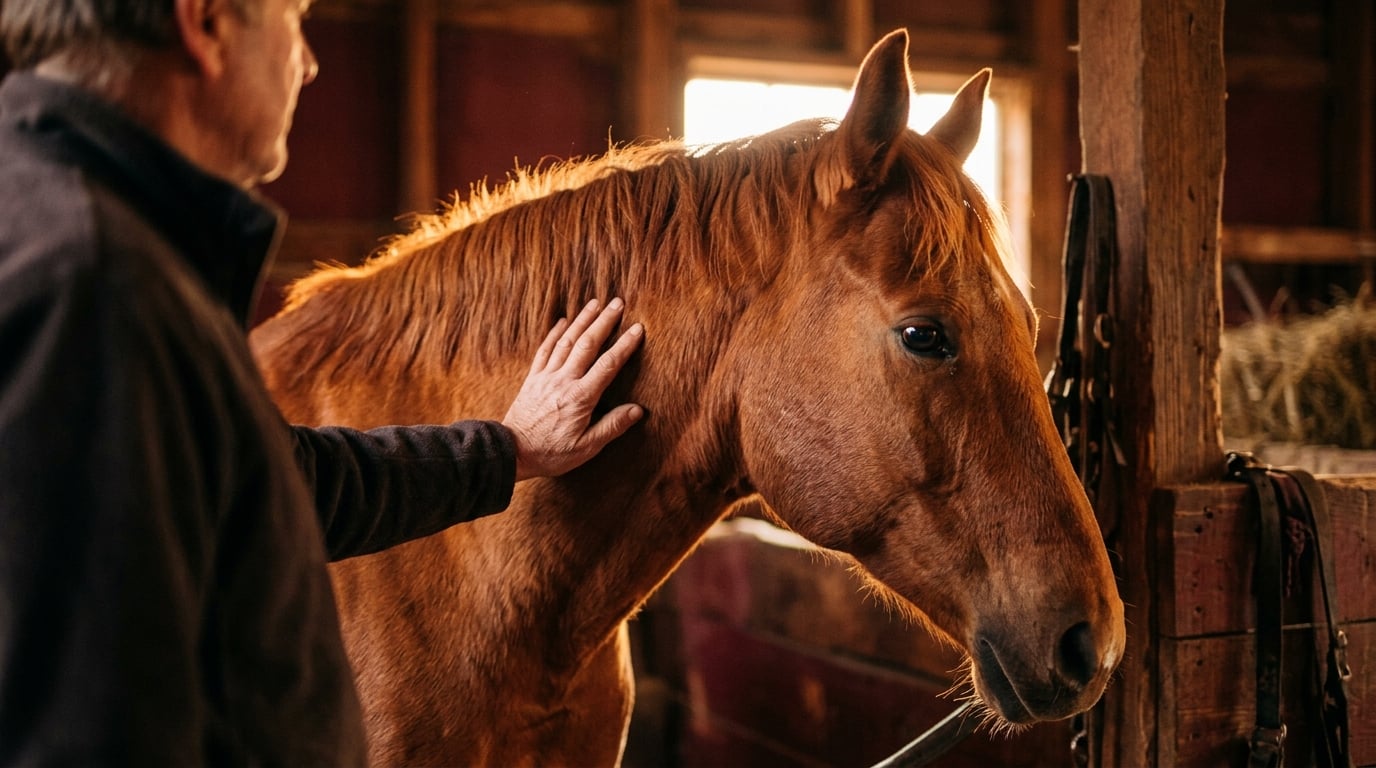
He was not sick. That is the thing I keep coming back to. He was just a little... off.
A little slower to come to the gate. A little less interested in breakfast than usual. Standing a touch apart from the others in a way that most people would have walked right past. I almost talked myself out of it — he is fine, you are being paranoid, horses have quiet days too. But something small and stubborn in me said check anyway.
It turned out to be the very early edge of a gut issue, caught early enough that a phone call and a small change fixed what could have become a very long, very scary night. And the only reason I noticed was that I knew what his normal looked like well enough to feel the difference.
Horses are professional stoics
We all know this and we all still forget it. As prey animals, horses are wired to hide weakness. By the time something is obvious — the horse that is clearly colicking, clearly lame, clearly ill — the problem has usually been building for a while. The art of good horse care is not reacting to the emergency. It is noticing the whisper before it becomes a shout.
And the whispers are almost absurdly subtle:
- Ate a little slower, or left a little behind
- Drank more, or less, than usual
- Stood in a corner when he is normally a busybody at the gate
- Manure that looked slightly different
- A dullness in the eye you would only catch if you really know that eye
- Just... off, in a way you feel before you can explain
The problem with "normal"
Here is the trap: you can only catch a change from normal if you actually know what normal is. And normal is not one number — it is a pattern. What he weighs across the seasons. What his usual appetite looks like. How much he typically drinks. His resting attitude on an ordinary Tuesday.
Most of us carry a fuzzy version of this in our heads. It works, mostly, until the day it matters and we find ourselves asking: is he actually drinking less, or does it just feel that way? Has he lost weight, or am I imagining it? Memory is a terrible instrument for measuring slow, subtle drift.
The horses whose people catch things early are almost never the ones with the fanciest care. They are the ones whose people know their baseline cold.
Learning to trust the small stuff
The day I described changed how I do things. I stopped treating the little observations as background noise and started treating them as data worth keeping:
- Write down the small stuff, even when it is nothing. "Ate slow this morning, seemed fine by noon" feels pointless — until three of those notes in a month reveal a pattern.
- Track a real baseline. Weight logged regularly becomes a trend line, not a guess. Same with body condition, appetite, the ordinary vitals.
- Note the nothing-days too. They are what make the something-day visible. You cannot see a change without a reference point.
- Trust the feeling, then check it against the record. That prickle of he seems off is real intuition — and it gets far more powerful when you can immediately look and see that yes, he has actually left grain three days running.
The goal is not to become anxious, hovering over every horse cataloguing flaws. Quite the opposite. When you have a baseline you trust, you can actually relax — because you will know, quickly and concretely, when something has genuinely shifted versus when it is just a quiet Tuesday.
Why I keep the notes
I log the small stuff in EquiNexus now — weights over time, health notes, the little "seemed off today" observations — mostly so that when my gut says something is not right, I can pull up months of history in a few seconds and see whether the pattern backs me up. That has turned vague worry into early action more than once. Any method that lets you see the trend works; a dedicated notebook you actually keep up with is just as valid. The tool is not the point. Knowing your horse's normal well enough to catch the whisper — that is the point.
Trust the small stuff. Write it down even when it feels like nothing. One day, it will be the reason you caught something early — and on that day, you will be so glad you did.
EquiNexus was built by a barn owner to take the mental load off days like these — keeping every horse’s meds, vet dates, and feeding notes in one calm place, so nothing important slips through.
Try it free for one horseNo credit card required.